In Israel, the Holy Land, the earth itself is indeed Holy! The earth where Jesus walked overflows with flowers and vineyards that depict nature as a visual symbol of rebirth. With the profusion of emerging plants and vast flocks of migrating birds, the renewal of spring is draping itself not only over the land but in the sky. God’s promises are abundant, too.
Isaiah, who could be considered a biblical prize-winning prophet of Nobel-like stature, transmitted our Creator’s words in chapter 35:1-2: “The desert and the parched land will be glad; the wilderness will rejoice and blossom. Like the crocus, it will burst into bloom; it will rejoice greatly and shout for joy.” The prophet goes on to write, “For I will pour water on the thirsty land, and streams on the dry ground” (Isaiah 44:3).
Israel is an arid land, upwards of 60 percent desert. How did God bring/transform His ancient land to the modern environmental miracle it is today? First, Israel’s environmental beauty flows through the Jews, originating with God’s biblical covenants about their Promised Land. In Genesis 17:19, God tells Abraham that Sarah will miraculously birth Isaac: “I will maintain My covenant with him as an everlasting covenant for his offspring to come.” The Bible includes more than a thousand verses bolstering the fact that God connected the Jews with the land, the earth.
Fast forward from God’s almost 4,000-year-old promises to the year 1910, when the land was called “Palestine” under the British Mandate—nomenclature that continued until 1948. The first communal settlement (kibbutz in Hebrew) was established south of the Sea of Galilee. Young Jewish men and women—mostly from Eastern Europe—responded with hopeful hearts to a movement that officially began in 1897 at the First Zionist Congress. Theodore Herzl, the visionary Hungarian-Austrian writer, had famously authored Der Judenstaat (The Jewish State) in 1896. The following year, he convened the first Zionist Congress in Basel, Switzerland. He is considered the Father of Zionism.
From about 1908 to 1910, several significant milestones materialized. Degania (Hebrew for grain and flowers) holds the distinction as the first kibbutz set up by young Jewish pioneers. Greeted by scenes of unhospitable sand, deserts, and swamps, they faced a formidable task. Not schooled in agricultural skills and beset by mosquitoes in malaria-ridden swamps, these pioneers determined to forge ahead anyway, learning how to farm and survive.
Using shovels, plows, and rakes, the sacrifices of the early “kibbutzniks” (members) of the kibbutzim (plural) laid the foundation for the Jewish state’s modern rebirth in 1948. They developed close-knit communities where they highly valued work, ate together, shared resources, and gave freely to one another. They relied on the principle, “to each according to his/her need.” In the early kibbutzim, they ran a direct democracy where each decision was made by all members.
As the kibbutz movement grew in pre-state Israel, it experienced the trials and tribulations of any pioneering effort. The movement was founded on socialist and Zionist principles that the pioneers brought from their previous countries. Prominent author and biblical translator Martin Buber at Hebrew University wrote in Paths in Utopia that the kibbutz was an experiment that didn’t fail.
In 1920, 12 kibbutzim existed with 805 members. By 2020 the kibbutzim numbered 270, with a population of around 170,000. Many are now privatized. They grow 34 percent of Israel’s crops and account for 9.2 percent of the nation’s industrial output.
The pioneers of Tel Aviv likewise grew from nothing—to nothing short of amazing! Around 1908–1909, a group of 60 Jewish families founded Tel Aviv on the coastline. They bought 12 acres of dunes and began building houses. They officially adopted the name Tel Aviv (Hebrew for spring mound) in 1910.
On one of my trips to Israel, I bought a simple black-and-white framed photo. It shows Jewish families standing on the beach looking, not at the Mediterranean, but up at the sand dunes. The 1908 photo shows their backs, not their faces. It’s an interesting photographic perspective. I’m guessing the families were imagining what they planned to build. The ladies in their long dresses and the men in their suits were forerunners of the many visitors to today’s top Israeli tourist destination! In their wildest imaginations, they could not have envisioned the beaches of today visited by millions of visitors and citizens each year. Tel Aviv is Israel’s financial center and the richest city in Israel. Some call it the “Mediterranean metropolis that never sleeps.”
Israel’s early pioneers knew that turning the desert into farmland and cities was a national priority. Their sacrificial hard labor, matched with organizational competence and vision, paved the way for Israel’s bounty. Despite their homeland’s distressing lack of natural resources, the Jewish people themselves were—and are—the true natural resources. Their water-related innovations have stopped desertification not only in the Holy Land but in nations worldwide to help grow crops and make use of smart water management.
Since 1901, the Jewish National Fund (JNF) has planted 250 million trees. Their successes are described on their website: “Covering over 250,000 acres, Jewish National Fund forests provide an invaluable green canopy for both the people of Israel and the roughly 2,241 different species of land animals and birds who call it home. From the mighty oak and the almond, to the cypress and the exotic Atlantic cedar, every tree makes a difference, every tree connects to the future, and every tree calls out, ‘Am Yisrael Chai.’” Long live Israel!
All the trees are planted by hand. For visitors, planting a tree in the Land is a special activity. On several of my trips, picking up a shovel and digging a small hole for my tree was so fulfilling. In a tiny way, I could follow the example of the Jewish pioneers. And a donation to JNF and other organizations means an Israeli will plant it for you to honor a loved one. This commitment to tree planting has really paid off: Israel is one of only a few nations that welcomed the 21st century with more trees than it had 100 years ago.
Arising from the pioneering kibbutzim enterprise, Israel today is teeming with bountiful examples of nature’s glory. In addition to the nation’s innovations in irrigation, water generation, and planting trees, its animals, vegetables, fruits, and birds are at once fascinating, beautiful, and enjoyable. Land animals like foxes and ibex constitute 116 species. With so many domesticated animals, such as Holstein cows, Israel leads the world in milk production. The Israel Dairy Board reports that kibbutz herds produce 64 percent of what Israel needs. In Exodus 3:8, God described Israel as “flowing with milk and honey.” For such a small country, Israel’s huge dairy cow production is remarkable.
Since the 1930s, Israelis have grown bananas by using special netting to protect them from high heat. In the 1970s Israel developed cherry tomatoes. And since 2008, Israelis have worked on cultivating ancient date seeds. They have found more seeds in the Judean desert at archaeological sites. Naming six of them—Adam, Jonah, Uriel, Boaz, Judith, and Hannah—scientists hope for date palms from these ancient seeds sometime in the future.
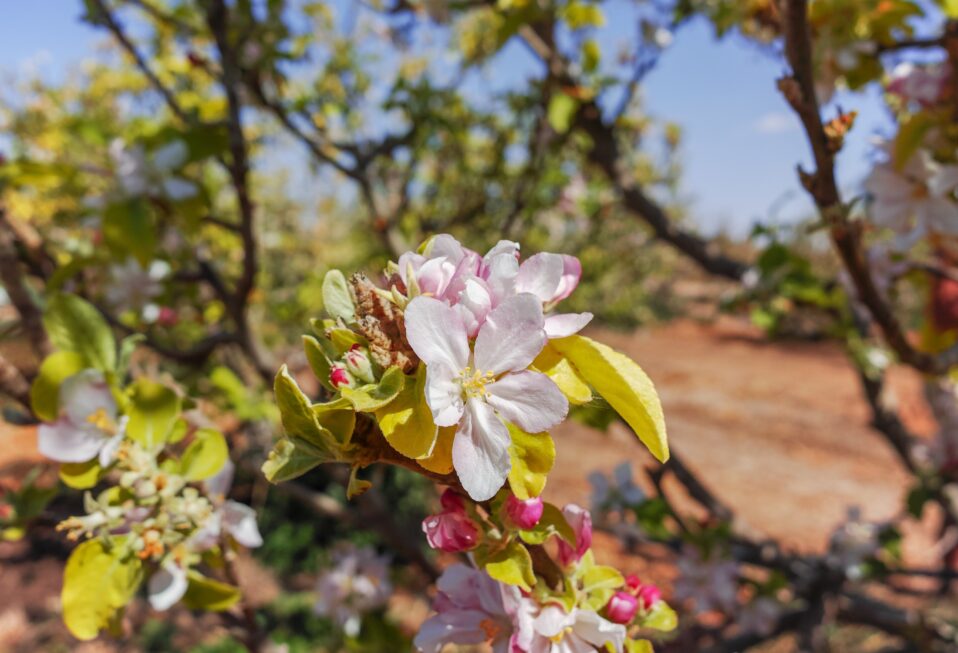
In Deuteronomy 8:8, God calls Israel “a land of wheat and barley, of vines and fig trees and pomegranates, a land of olive trees and honey.” The olive tree, not surprisingly, is Israel’s national tree. With 2,600 native species of plants, Israel blooms profusely—with dramatic roses, lilies, tulips, carnations, iris, and gladiolas. And the small beautiful national flower, the anemone—also called the windflower—waves and dances on hillsides and in gardens.
Gardens are found throughout Israel, beginning in the north at Haifa’s Baha’i Gardens, which draw half-a-million visitors every year. The gardens are so spectacular that the United Nations Educational, Scientific and Cultural Organization (UNESCO) designated it as a World Heritage site. The 30-acre Jerusalem Botanical Gardens and the Wohl Rose Garden are major attractions in the capital city. Further south, the Eilat Botanical Garden features 1,000 species of fruit trees, offering a green oasis in the middle of the desert.
Annually, 500 million birds fly round-trip over Israel as they migrate between Europe, Asia, and Africa. Israel itself has 70 native birds. In 2008, Reuters reported an interesting bird story. Israelis voted for the Hoopoe (Duchifat in Hebrew) as their national bird. The Hoopoe is mentioned in the Old Testament, but it’s forbidden as food, as are the eagle and pelican. The colorful bird is extraordinary with its long bill, crested head, and pink, black and white colors. The Hoopoe is unique, like Israel itself.
One of the proofs that Israel is the Jewish homeland cannot be ignored. Since they have returned from exile, Israelis have created a brilliant canvas of Israeli nature that has thrived under its rightful owners. The Jewish Agency reports that between 2009 and 2019, the largest numbers of immigrants—out of a total of 255,000—were from Russia, Ukraine, France, the United States, and Ethiopia. Jews from 150 nations have come home to their Holy Land, fulfilling Scripture.
Join CBN Israel in praying for Israel and her people this week:
- Pray that Israel’s innovations, in nature and beyond, will continue blessing our world.
- Pray for Israel’s economy to boom as the nation emerges from COVID-19 lockdowns and restrictions.
- Pray for the people who have been broken by this pandemic to be restored in every way.
- Pray for tourism to return to Israel not only for the sake of the Israeli economy but also so that people around the world can experience the Holy Land again.
- Pray for Israel’s fourth election in two years on March 23, 2021 and that the government will be able to work together for the good of the country.
May we praise God for all the promises He has fulfilled for His chosen people: “For the LORD will comfort Zion, He will comfort all her waste places; He will make her wilderness like Eden, and her desert like the garden of the LORD; joy and gladness will be found in it, thanksgiving and the voice of melody” (Isaiah 51:3).